Saturday, March 26, 2022

Roadboy Visits The Rijksmuseum

Unfinished Business

During a past trip to the Netherlands my daughter and I spent a few days in Amsterdam riding bikes, visiting flea markets, and enjoying the beautiful canal side flower markets. 

On that trip though we could not visit Amsterdam's hallowed Rijksmuseum as it was in the midst of an epic and very tortuous decade plus restoration effort. After that trip I vowed to return after it reopened.

Then, even when construction was complete, the reopening was delayed for one issue after another. The last was a squabble whether or not to preserve the cycle passage bisecting the building. 

Since bikes are a religion in Amsterdam, the cyclists won (Yay!) and the Rijksmuseum finally reopened.

The Festive Forecourt of the Rijksmuseum

(the arched area in the center is the contentious bike passage)

Fast forward to May 2020 trip. I had a trip planned to see tulip fields, return to the Rijksmuseum and visit Rotterdam to take in its striking contemporary architecture. 

Hard stop Covid.

So this fall, after waving goodbye to my cycle buddy in Spain, I boarded an $80 flight to Schipol. 

Upon landing I immediately realized the Dutch had a very laissez faire attitude regarding Covid (i.e. there wasn't really any precautions noticable?) This was a shock after our time in Spain where people were wonderfully courteous about distancing and masking.

All that said though I'm lucky I was there when I was, as three weeks later Holland had to close again due to its (duh?) surging Covid infection rates. You reap what your sow (just ask America as we pass the tragic milestone of a million documented Covid deaths while idiots argue on their deathbeds about their right to remain unvaccinated). So much for doing the right thing for the good of society.

This trip I spent an entire day immersed in the Rijksmuseum before traveling on to Rotterdam (the tulips part of the trip will have to wait for some other trip).

Here is a small selection of some of Roadboy's favorite images from the Rijksmuseum.


French Prince

(terra cotta 1555-1560)

Note the youthful and mischievous attitude of this future king captured in this sculpture. It is assumed to be Henry III at about age 9. The son of King Henry II and Catherine de Medici this prince was known as a bit of an 'enfant terrible.

The Maritime Model Room

The basement maritime hall was high on my list of favorite exhibits in the museum. It showcases the incredible technical maritime skill of the Dutch in exquisitely detailed models of their ships and even the prefabricated lighthouses the Netherlands once produced and shipped worldwide.

Details of the Ship Models

Heading into the museum's grand halls I spent some awestruck moments just watching conservators performing a painstakingly detailed technical analysis of Rembrandt's most famous painting "The Night Watch". The painting is being analyzed using x-rays, digital analysis, and AI in hopes to accurately determine how it may have looked before it was trimmed 300 years ago to be installed in Amsterdam's Town Hall.
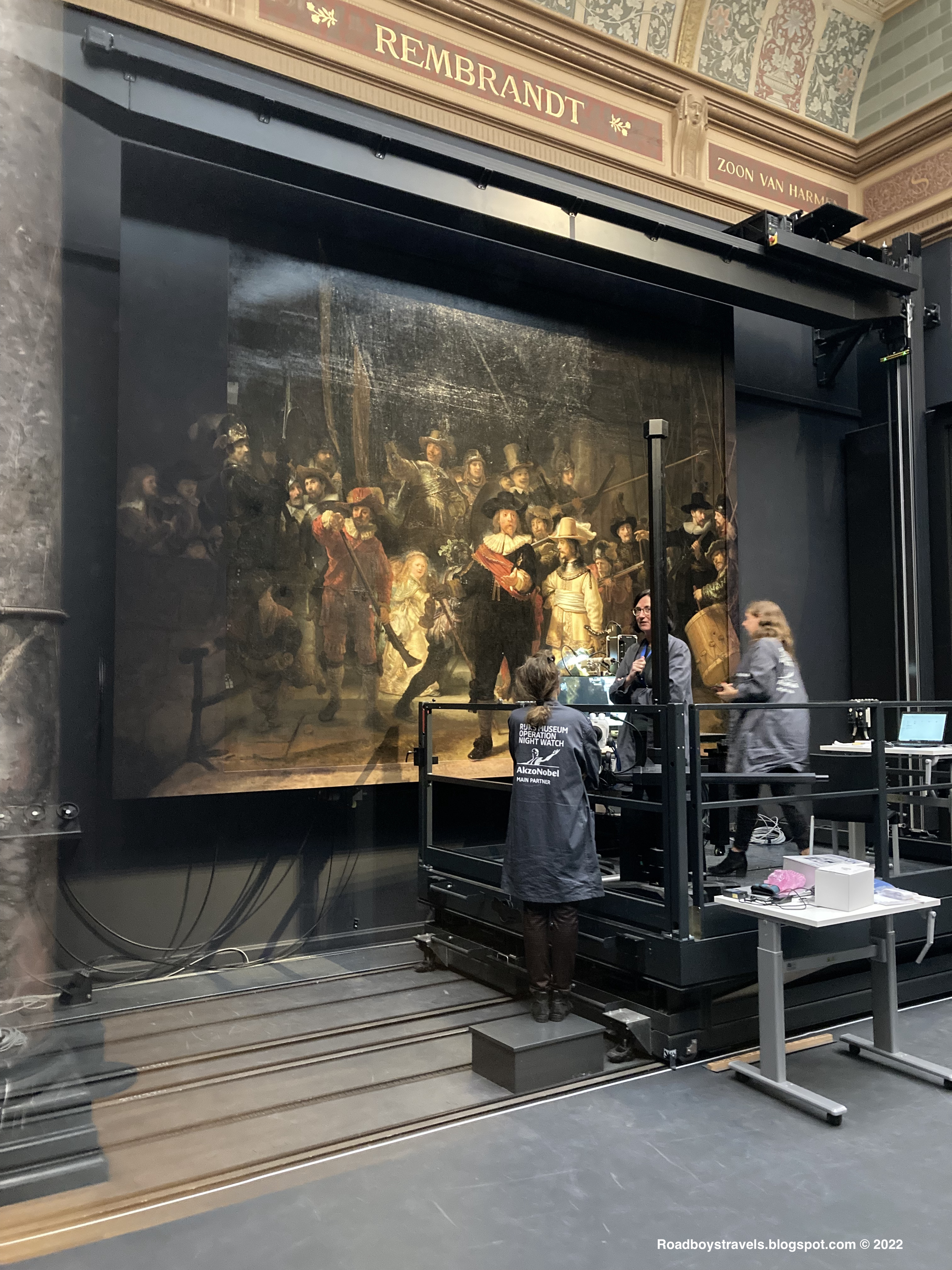
The Night Watch Analysis Team


The Militia Company of Captain Roelof Bicker

Bartholomeus van der Helst, 1643

This enormous (7.5 M long) painting celebrated a military militia in a somewhat loosely structured manner. The painter even included himself in the painting. In the very center of the painting is Captain Roelof Bicker. Interestingly, almost concealed under him is his red caped African "servant". Sadly, the inclusion of the enslaved African child was not out of respect, instead it was meant to symbolize Bicker's wealth. Interesting is how the hypocrisy of the time is overtly portrayed in a painting when, at that very time, the law in Amsterdam stated "Within the City of Amsterdam, and its areas of law, all men are free, and none are slaves".

Servant or Slave?

With the Dutch being a major player in the global slave trade, the museum has appropriately added notes describing Holland's role in shameful exploitation of human lives.

Elaborate Doll Houses

In the late 17th and early 18th century wealthy women in Amsterdam enjoyed the fad of commissioning wildly spectacular doll houses. Many of these elaborate doll houses cost as much as the real mansions they lived in. Now these models offer a pretty accurate glimpse into the homes of a long past era. 

Doll House "Nursary" Detail

I really appreciated many of the sculptures in the museum. This one was likely the last major sculpture of Hans Hilger. Cast in the 1626, the loose, spontaneous pose of this piece is considered centuries ahead of its time. Bacchant likely originally shouldered a long since lost globe.

Bacchant

Portrait of Rembrandt van Rijn

Jan Lievens 1628

This portrait of Rembrandt was painted by his friend and studio mate Jan Lievens. Lieven's imitated Rembrandt's style of dark backgrounds and tiny scratches in the paint (to give Rembrandt's neck scarf its texture).
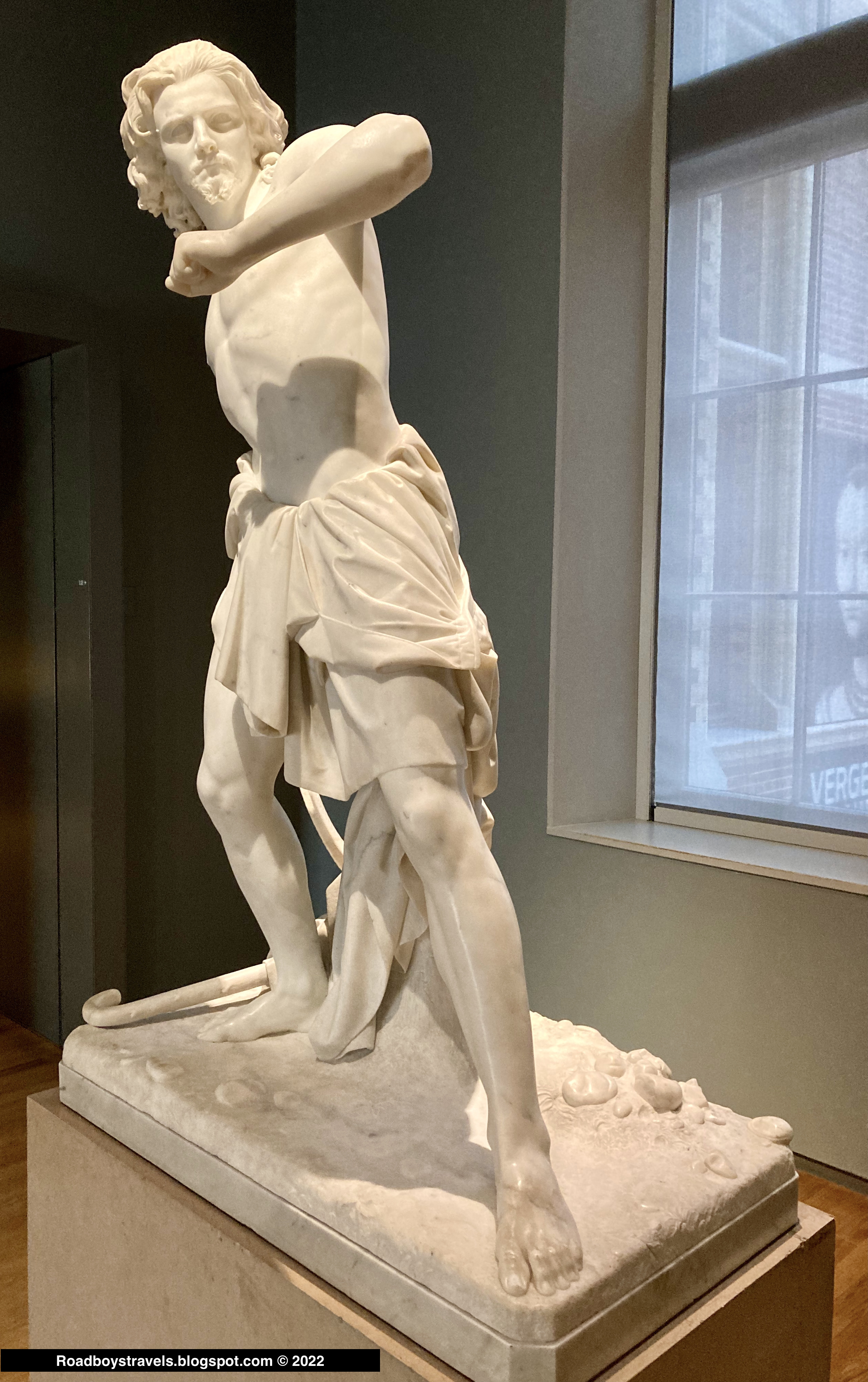
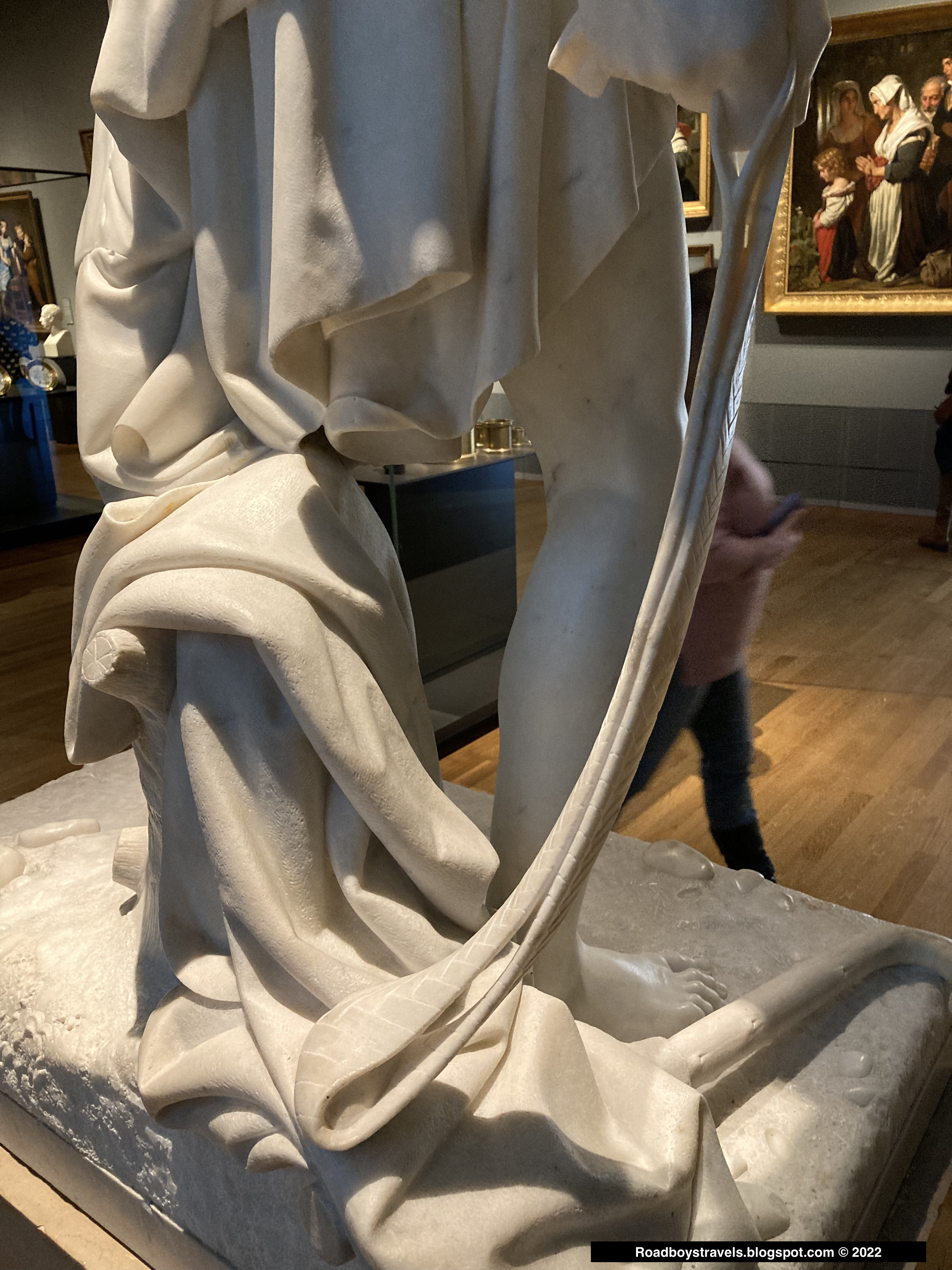
David
 
Pietro Magni 1851

The exquisite detail of this sculpture is what attracted me. Even David's stone slingshot strap looks like it is just draping in repose waiting for the shot to fell Goliath. Magni sculpted David in the image of the Italian General Giuseppe Garibaldi in tribute for his freeing Milan from the Hapsburg Empire.
 

David's Famous Slingshot

The Death of Pharaoh's Firstborn

Lawrence Alma-Tadema 1872

The highly stylized portrait of a grief stricken Pharaoh drew me from across the room. It portrays Moses and Aaron (top right) visiting Pharaoh after his son has died from the plagues sent to convince Pharaoh to let Moses and his people escape Egypt.

Government Opium Presentation Box

Beside the sin against humanity engaging in the global slave trade, the museum presents this chilling sales presentation box. It demonstrates the quality of the opium product's the Dutch pushed in its Imperialist expansion into the Dutch East Indies. Private opium trading was illegal as the government retained a total monopoly on its extremely profitable manufacture and sale.

Self Portrait Vincent van Gogh

Vincent van Gogh 1887

One of Van Gogh's self portraits painted using oil on cardboard. The self portraits reflect poverty rather than vanity as he had little money to pay for models.

Man and Machine
Marinus Johannes Hack 1913

This sculpture was placed at the entry of an office building that exported machinery to the Dutch East Indies. The Javanese man cradles the modern diesel engine that the company hoped to expert to Indonesia. 
 
It spoke to me as I am a fan of site specific art. To me art that is an essential element of architecture brings harmony. 
 
This is in contrast to some of the plop art that adorns (lands) without context in the public plaza's of many of today's modern buildings.  
 

Roadboy's Travels © 2022

Monday, December 27, 2021

Roadboy Cycles Northern Spain 2021

Days 5-7 Roman Bridges, Haro Wineries and The Guggenheim Bilbao

Day 5 

Day 5 rewarded us with a stunning 41 mile ramble through the Oja Valley along La Rio Oja with a lunch stop in Haro. Haro is a hilltop city that self-proclaims itself as the capital of the Rioja region.

Community River Laundry 

The River Oja, Banares

Our first stop, Banares, was especially picturesque. The Banares community maintains some beautiful public spaces including an public outdoor laundry pavilion (fed by the Oja River). The community also has a prominent stone jai alai fronton along the river, as well as public plaza's and beautiful churches.

Not far from Banares was the tiny village of Cihuri where we diverted off our main cycle route to view an elegantly arched Roman Bridge dating back to the second century.

Roman Bridge in Cihuri

Over my lifetime I keep being reminded that, while the Greeks presented civilization with its most heroic advances in ancient art, the Romans stand as the world's most accomplished ancient engineers.

The fact that we viewed one, and safely crossed another, Roman bridge in today's ride tells a story about building for the ages. 

While modern American society lately tends to opt for the least costly way to build public structures, bridges and highways (resulting in a nation filled with crumbling infrastructure) these elegant arched bridges make the case for designing beautiful structures that last.

From here we pedaled along the River Oja through rich farmland and huge aligned groves of tall poplar trees (harvested for use in making crates) on our way to Haro.

Haro

Haro turned out to be a wonderful spot to enjoy food and drink. We began with plates of its famous spicy potatoes (patatas bravas) washed down with wine or beer. After that we found a local pub known for its skewers of mushrooms. 

After lunch we set off to find Haro's famous, and indescribably soft, chocolate wine truffles. I bought some to transport home, but precious few actually made it home.

Haro is also known as the home to the annual "Battle of Wine". Every June 29, after a mass is held, throngs of participants take to the streets of Haro to throw thousands of liters of wine at each. Think of it as the boozy version of the Buñol's annual tomato throwing event.

The festival is the offshoot of a disagreement between Haro and Miranda de Ebro over the rights to some cliffs. In this part of the world many disagreements are resolved with wine.

After lunch we rode over a second Roman bridge this time spanning the River Ebro on our way to the little village of Briñas and another beautiful hotel; the Palacio Tondón.

The River Ebro from the Hotel Palacio Tondón

We gathered for a wine tasting in the Hotel's own Bodega and then dinner in a local restaurant that served the piles of the most wonderful grilled lamb chops I have ever eaten. 

After lots of wine and a mountain of lamb chops I crawled of to my room and slept like a pup. 


Day 6

Upon awakening we boarded a shuttle up to the hillside village of Berganzo to embark on our last major ride. Today's ride took us downhill into the rich farmlands of the Canyon of Billium. The roads through farms and vineyards were quiet; some hugging hillsides and others passing through rock hewn tunnels. On two wheels the ride was spectacular. 


Farms of the Conchas de Haro


Gloriously Empty Roads

Once again we ended our ride in Haro at the Bilbainas Winery. But today we enjoyed a wine tasting in the gardens of the Bodegas Bilbainas before being shuttled into the vineyards themselves for an elegant picnic lunch served in an ancient stone structure. The wine industry in the Rioja region is clearly in its ascendance.

Bodegas Bilbainas

Our Guides Itziar and Jose

As with all VBT's tours the last evening we gathered for a farewell dinner. 

After 9 European cycling adventures, this one was really special. We made friends with amazing riders from all over North America. We experienced wonderful cycling, ate amazing food and enjoyed remarkable wines. But more than that, we came to love the people, history and beauty of Spain's extraordinary Basque region.


Day 7 

The morning of our final day we boarded a shuttle, bid our terrific guides adieu, and set off to Bilbao.


Saying Goodbye to Jose and Itziar

For an architect today's shuttle ride was full of anticipation as our destination in Bilbao would include a visit to Frank Gehry's 1997 Guggenheim Museum Bilbao.

IMHO this is the masterwork that served as the tipping point in Mr. Gehry's career (a reputation reinforced in 2003 by LA's Disney Hall).
 
The building merges a remarkable site which presents the structure differently from nearly any angle. Although it enjoys a waterfront location, trains and buses run through the building and a major highway runs right over it.
 
The Guggenheim
 
The 120,000 square foot building completely overwhelms most of the artwork it was built to house. The glass, limestone and titanium building itself is a sculpture meant to be walked through. 
 
Since this building speaks for itself. I will rely on images, rather than words, to describe it.
 

The Building in Model Form Demonstrates its Complex Relationship to its Site.
 
Special Software had to be Developed to Create the Building

A Composition of Sensuous Shapes


 The Largest of the Guggenheim's Nine Galleries Houses
Richard Serra's The Matter of Time
 
After our brief visit to Bilbao we boarded return flights to Madrid to overnight. In the morning I continued on to The Netherlands for a quick visit to Amsterdam and on to Rotterdam.
 
 
Roadboy's Travels © 2021

Sunday, December 5, 2021

Roadboy Cycles Northern Spain 2021


Cycling the Way of St. James and a 2-Star Michelin Experience

Days 4-5

When we checked into our hotel in Ezcaray we knew we'd arrived someplace special. Guest rooms in the Echaurren Hotel Gastrónomico are beautifully designed. My room had the bed perfectly centered to the room with a closet designed to be thoughtfully accessible from both the entry and the dressing / bath area. A plush mohair bed topper turned out to be the creation of by local weavers who, coincidentally, weave specialty products for design houses like Prada and Gucci.
 
The hotel's main claim to fame is its multi-generational family ownership and well earned international reputation for fine dining. It's signature restaurant El Portal opened in 2002 and quickly garnered recognition from Michelin.
 
After sleeping like a pup I awoke the next morning and enjoyed a hearty breakfast. We then set off to collect our bikes and I, at this point, realized I had not planned well as I could see my breath in the crisp morning. 
 

 Crisp Alpine Cycling in the Morning
 
The frosty morning ride began uphill in the lovely alpine Oja Valley. A valley that, sadly, remained in complete shade the whole ascent (I'd have killed for my tights and a pair of full finger gloves).

Coming down we stopped in a little family run cafe for coffee and some free general warmth before returning to Excaray. From Excaray we then began our afternoon ride. This ride was (gloriously) in full sun 🙂 and chills from the morning melted away quickly.

Stopping for a Warm Cup of Coffee

The stretch from Excaray to Santo Domingo de la Calzada was spent on a lovely very quiet rail to trail cycle path. This route delivered one beautiful vista after another along the way.   

Glorious Rail to Trail Cycling


 Every Stop Along the Way Delivered Beautiful Vistas

Upon arrival in Santo Domingo de la Calzada we encountered lots of pilgrims on the Way of Saint James as it is part of the "French Way" routing. The symbolism for the pilgrimage is a seashell which is etched in stone pavers designating the route through the city. It was a great spot for lunch and the perfect place to try the famous Rioja wine truffles created there.

Pilgrims Frequently Sport Shells on their Backpacks

Upon arrival back to our hotel we dressed for dinner wondering what a 2-star Michelin dinner would be like. First off we were escorted to a lovely room with a fireplace to enjoy an infusion and some appetizers. We agreed the olive s were the best we'd ever eaten. When pressed our waiter confessed they were an amuse bouche. The chef created them from cheese, anchovy and red pepper to look like olives, but they weren't olives at all. 


Faux Olives, an Herb Infusion and Heart Tartare on Oyster Leaf

It is safe to say we'd have been hard pressed to consider something like heart tartare, but it turned out to be magnificent.

Second  Stop the Pintxo Bar

We started the pintxo course with El Portal's take on the classic "Gilda" (center) accompanied by sweetbreads and caviar (left) and choicero pepper with crusty corn on the right.

Each course was more colorful and creative the the one before. There was oyster and nettles, marrow and green beans, red scorpionfish, foie and speculoos. In a meal featuring 27 courses(!) I found only one item I did not really love. 

The Creative Force Behind our Dinner
 
Memories of our dinner at El Portal will always conjure up a smile. If you are lucky enough to secure a reservation here you will soon come to fully understand why! 

After dinner it was off to bed knowing we would be cycling to Haro in the morning.


Roadboy's Travels © 2021

Thursday, November 11, 2021

Roadboy Cycles Northern Spain 2021

Cycling Northern Spain: Basque, Navarre & Rioja Wine Regions

Hemingway's Pamplona, Cycling the River Arga and a Vineyard Ride

Days 1-3

When it comes to travel I count myself as very, very lucky. Circumstances have allowed me to circumnavigate our beuatiful planet And, with every journey I discover new insights into our world. 

When I was young travel was a rush. We had to move fast to "see" everything. Now, well into my AARP years, my pace is unhurried and I actually "see" the nuances of places I travel with a point of reference that has been enriched by life and decades by the little strands of history now magically knitting together rich stories all reinforced with every new image I encounter along the way. 

And these days, the pace of travel spent straddling an "e" bike is perfect.

So, for my second cycling adventure this year (first was Martha's Vineyard / Cape Cod) we chose Northern Spain. This is the trip we missed out on last year when it was cancelled due to covid. 
 
This year we confirmed the trip as soon as Spain reopened to vaccinated US tourists.
 
Travel in 2021, however required flexibility. We got a call informing us that the particular dates we'd booked were short of guests (so many Americans still timid about international travel) so Vermont Bike Tours (VBT) was only able to run two groups for this itinerary in 2021. And this is an itinerary that in a normal year would sell out. We were offered, and jumped on spots with an earlier group.

And rolling the dice paid off handsomely.  We joined some wonderful cyclists from Colorado and Minnesota. The trip began on a shuttle from San Sebaastián into the cloudy nearby mountains to a small village where we met our guides, received our orientation and become acquainted with our bikes. 
 
Then, we set off on a lovely 22 mile downhill "warm-up" ride through the tranquil Laurran and Araquil River Valleys. 
 
Bliss.
 
A Snack Stop on the Warm-Up Ride

After the warm-up ride we shuttled to Pamplona and the same wonderful hotel Earnest Hemingway called home wirting his two famous in two novels set in Pamplona. 
 
The evening was capped by a wonderful welcome dinner at Ábaco. The dinner included veal nigiri, tomato smoked sardine / garlic soup, squid ramen (so good!), pepitoria style chicken and a desert of pistache baklava and petit fours. I found everything both beautiful and delicious.
 
 
Hemingway & Pamplona; Inseparable
 
The very name Pamplona triggers imagery of crazed runners in white pants and red scarves chased through narrow streets by six bulls. The "running" still takes place every July during Pamplona's 9 day festival in tribute to Saint Fermin. 

I really tried to discern the legend surrounding Saint Fermin and simply came to realilze the legend really doesn't matter. There are just too many intertwined stories to sort out.  People  just come to be of the moment; many reckless enough to run with bulls.
 
There are only three rules to run with the bulls, You Must:
1. Be 18 years old
2. Run in the same direction as the bulls and 
3. Be sober
 
There is no requirement about sanity and every year between 50 and 100 people sustain serious injuries in the 2-1/2 minute run. In fact, 15 runners have died since 1910. One suffocated, the rest were gored to death. 13 fatalities were Spainish nationals, 1 was Mexican, 1 was American.


Gran Hotel La Perla Pamplona
 
Day two's ride had us cycling loops along the mirror smooth Arga River. This was a liesurely ride on trails with lots of locals. Very nice.
 
Upon return to Pamplona we had light a light pIntxo lunch and used a little free time to explore Pamplona. 
 
In the evening the hotel offered us a tour of Hemingway's lovingly preserved hotel suite.
 
 The Hemingway Room in the Gran Hotel La Perl
 
Afterwards we were pared with local college students to go sample local wine and beer while "pintxo hopping". Our two students were from Costa Rica. They had a great sense of humor and offered a very honest personal appraisal of thier time living and studying in Spain. They were adorable.

Pintxo Hopping with Local College Students

Pamplona Nightlife Was Relaxed and Fun

 
Assembling for the Rioja Vineyards Ride
 
Day three was an exceptional ride. A sunny, cloudless day, calm winds and a 30+ mile mostly downhill ride through the exquisite Temperanillo Vineyards of Rioja. Along the was proud growers encouraged us to stop and sample grapes fresh from harvest. We happily obliged.
 

Rioja's Tempranillo Harvest was in Full Swing

Perfection

Spain's Scenic Rioja, Navarre Wine Producing Area

The Temperanillo

My ride was made even better when we encountered the Ysios Bodega designed by Spain's master architect (and a very personal hero) Santiago Calatrava.

 
Calatrava's Ysios Bodega (Winery)
 

Ysios

We also encountered a number of Dolman sites along our route. We stopped at the most distinctive one known as the "Witches Hut". These are neolithic burial sites date back 3300 and 5000 years. This dolman was discovered in 1935 and houses human remains of 39 along with beads, pendants and arrowheads.

The Witches Hut Dolman (Burial Site)

Our ride ended at the walled hilltop town of Laguardia. Here we had lunch and visited the Bodegas Carlos San Pedro Pérez de Viñaspre (wine cave). This family has been producing exceptional Rioja wines for 300 years.


Lunch and WIne in Laguardia

Wine tasting at Bodegas Carlos San Pedro Pérez de Viñaspre (Wine Cave)

From Laguardia we shuttled to the village of Ezcaray to enjoy a stay at the exquisite Echuarren Gastronomic Hotel.

Roadboy's Travels © 2021