The Cycling Begins
When viewed on the map Vietnam is a very long and narrow country; sort of a bent figure eight. Hanoi is at the top, Ho Chi Minh Cty at the bottom and Hué sort of in narrow the middle squeezed between the mountains and the sea.
And, after just a few days in the anthill that is Hanoi our arrival into Hué, with its population of 427,000, felt downright peaceful.
Hué is almost in the center of Vietnam was the northernmost part of South Vietnam. Its strategic location near the DMZ meant it was the site of incredible bloodshed during Tet Offensive.
Hué is set along the Huong River and just a few miles inland from the East Sea (due to China's expansionism Vietnam and its neighbors now refer to the former South China Sea as the East Sea).
Despite December being part of Hué's "mild" season, compared to Hanoi, Hué immediately crushed us with heat and humidity.
Our
first stop was a tour of the Imperial City and Citadel. The complex has
a series of walls and moats enclosing a series of gated courtyards and
inner walls and moats. Construction on Hué's Imperial City began
in 1803 and served until the imposition of the French Protectorate in
the 1880's.
This remarkable site was symbolically left derelict by the
communists at the conclusion of the Vietnam War. However since its designation as a UNESCO World
Heritage Site in 1993, and its rising popularity as a major tourist destination (it now receives more than 4,000,000 visitors a year), it is now undergoing meticulous restoration efforts.
The Citadel, Imperial Walled City, and Purple Forbidden City
Entering the Imperial Citadel
The innermost zone of the original complex was the Purple Forbidden City which was
restricted to the imperial family. The whole complex, oriented to face the Huong (Perfume) River to the southeast, Hué's Purple Forbidden City differs from
Beijing's Forbidden City which faces due south.

The Citadel / Imperial City has been heavily ravaged by storms, wars, termites, and neglect. In
1947 it was seized by the Viet Minh. The French responded by mounting a six week
French counter-attack resulting in many of its original buildings (including the
Imperial Palace) being burned.

Gardens Within The Forbidden City

Restoration Work
The site was massively damaged during the Tet Offensive when the Peoples Army of Vietnam and the Viet Cong launched a coordinated attack on Hué. When US forces arrived to retake Hué they entered the site with orders to not bomb the historic areas. But, as casualties mounted, protective orders were lifted and by the end of the battle only 10 of the original 160 structures survived. The site still bears numerous scars from bullets fired during the war.
Symbolically today the Citadel now supports the tallest and largest national flag flown in Vietnam.
After our tour we checked into our hotel The Pilgrimage Village. It was a wonderful antidote to the noise and confusion of Hanoi. The Pilgrimage is set on a tranquil and beautiful site. I've stayed in many amazing hotels over the years. But, I have to say the Pilgrimage resort ranks as truly something very special.

Our Poolside Accommodations at The Pilgimage
Guest suites are placed throughout the resort's highly manicured grounds. It boasts a comprehensive spa, multiple pools, various ponds (with very energetic frogs at night), an excellent upscale restaurant and an amazing breakfast pavilion. Pilgrimage staff all offered smiles and bright and sincere Xin Chào greetings. At twilight, howler monkeys, could be heard in the trees nearby.
Due to a personal connection of one of our guides we were upgraded to extra wonderful rooms with semi-access to semi-private pools.
My Room at the Pilgrimage Village
The Main Pool at the Pilgrimage Village
In Hué we began the biking part of our vacation. And after arrival and a chance to settle in at the Pilgrimage we had a bike fitting, safety orientation, and our warm-up ride.
For those familiar with more typical VBT tours, this tour is a big change. It is unlike any of my previous 12 VBT tours. First off it is a full 10 full days in length compared to the usual 6 days of VBT's normal trips. And, here everyone rides together with one guide riding in the front and the other riding in the back. Still everyone can ride a their own pace with little chance of anyone getting separated.
This trip is supported by an additional pace crew that discretely accompanies all the cycling with 3 minivan drivers plus a transport truck. If a rider gets a flat someone appears immediately to swap out a tire and wheel.
If a rider opts to end riding for the day a minivan is there to pick them up while the transport truck is there to pick up the bike.
The crew advances ahead to each intersection before we got there and made sure we were directed properly. This is the only tour I've been of recent years where riders really did not need the Ride With GPS travel app VBT uses.
The warm up ride tracked some scenic farmlands with lots of birds. When we came upon our first cemetery everyone stopped in awe. It was fascinating to see these big elaborate raised memorials. However we'd soon learn over the next few days that these amazing cemeteries are seemingly everywhere. They are so common (and consume so much valuable farmland) that the government is now offering financial incentives for families to avoid these big family burial memorials.

A Traditional Cemetery
Of interest was that the government has made provisions allowing the original "boat people" refugees that left Vietnam for the US at the conclusion of the war the ability to return as seniors to be buried in Vietnam. They return yet must leave the families they created in the US.
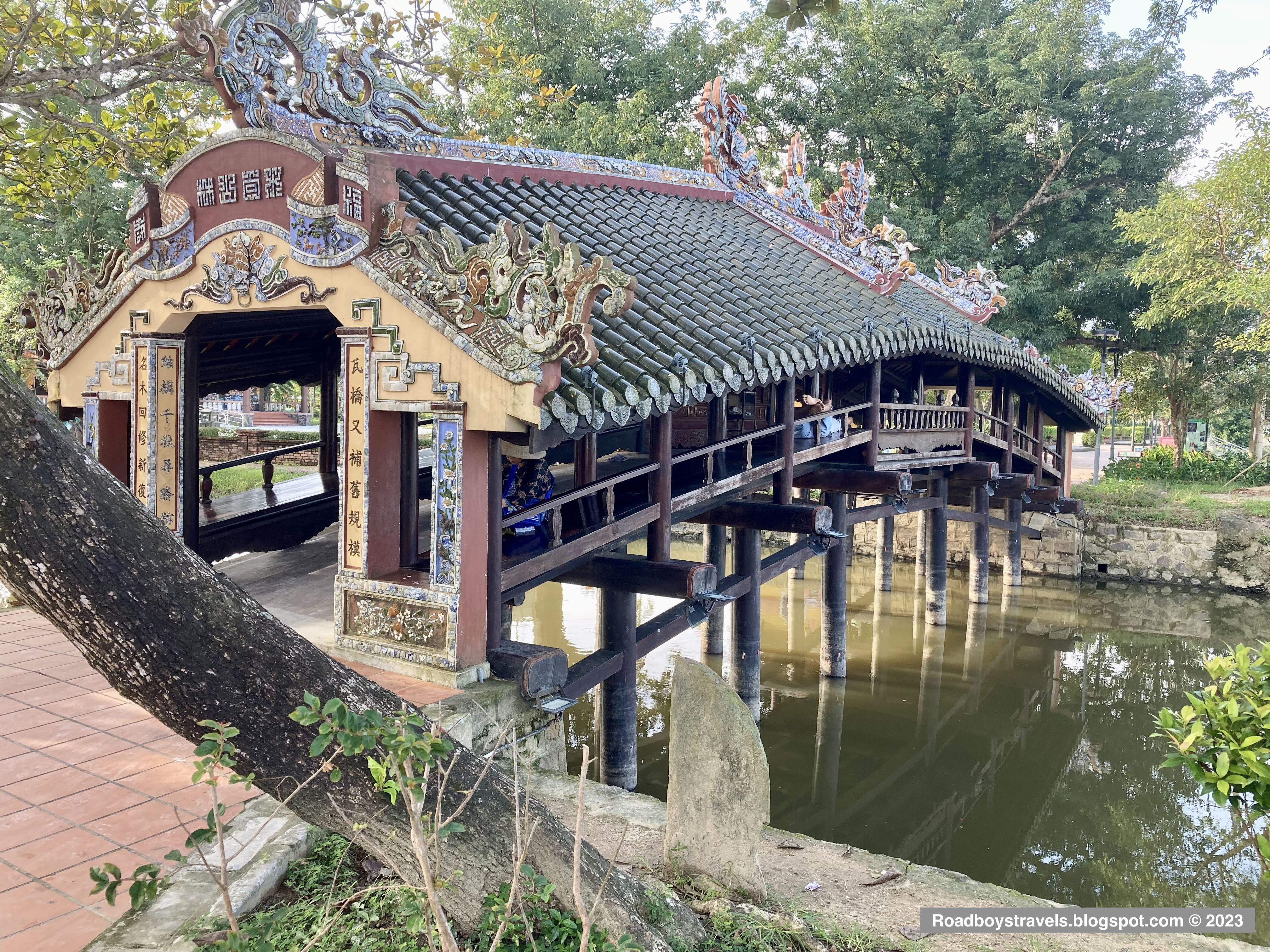
As we rounded a corner in one village we encountered this wonderful covered bridge. The entrance at each end was adorned with a bat motif. as the bridge was shady it was filled with locals eating lunch or were taking and afternoon nap.
Bat Bridge
Riding along the canals we noted these stainless steel fishing boats at anchor along the way. Upon closer inspection we saw they were assembled using sections of fuselages from downed American jets from the Vietnam war.

Jet Parts Repurposed into Fishing Boats
After breakfast day two we toured Emperor Khai Dinh's Mausoleum. The elaborate mausoleum was designated a UNESCO World Heritage site in 1993. Khai Dinh, the twelth Emperor of Vietnam, had a relatively short a 9 year reign from 1916 to his death in 1925.
Over his life he was never fully embraced by the Vietnamese public. Although he was likely gay, he fathered the last Emperor of Vietnam Bào Dai.
Construction on the mausoleum began in 1920 and continued until 1931 (6 years after Kai Dinh's death). It is reported that he levied an enormous tax on his subjects to finance its construction.
The mausoleum is compact, yet exquisitely detailed. It is composed of architectural elements that borrow from Vietnamese, Chinese and European motifs. It is reached by climbing a wide steep staircase that leads to forecourts, temples, and additional stairs.
The Lower Forecourt With Protective Mandarin Statues
Upon entrance to the tomb itself you find Kai Dinh seated on an elevated sunburst throne cast in Marseilles. The ceiling is a spectacular fresco and wall panels are composed of inlays of broken pottery fragments (similar to those found at the Imperial Palace).
Throne Sculpture in the Tomb
Rows of Mandarin Forecourt Sculptures
After the visit to the mausoleum we collected our bicycles for a ride along the Perfume River. The river name is the result of the fragrant blooms that collect in the river in the fall from upriver orchards. Along the way we stopped at a market. Literally everything is for sale here from snakes to flowers, housewares to fresh produce.
Market Day
Fresh Seafood in Abundance
Our ride ended at the Thien Mu (Heaven Happy Fairy Lady) Pagoda and temples. The 7 story pagoda was constructed in 1884 and is the highest stupa in Vietnam.
This site became a major organizing point for the Buddhist movement and a site of major protests during the summer of 1963 after South Vietnamese President Ngo Dinh Diem's regime continuously showed strong preferences for Catholics and engaged in discrimination against Buddhists.
As a chilling historical reference to the protests, the auto driven by Buddhist Monk Thích Quang Duc to the busy intersection in Saigon where he set himself on fire is displayed.
President John F. Kennedy said in reference to Malcolm Browne's photo of the self-immolaton that "No news picture in history has generated so much emotion around the world as that one".
Despite being only 8 years old when I first saw the burning monk photo it would become an image I'd never ever be able to forget.
Buddhist Protests in 1963
After visiting the Pagoda site we crossed the street to the river to a waiting "Dragon Boat" for an elegant lunch cruise along the river.

Hue's Dragon Boats
Our guides pointed out that most of Vietnam has only two seasons: Hot! and Damn Hot! After a full day of cycling in what they only view as Hot!, I can only imagine what summer's here are like.
This was to be our last night in the completely amazing city of Hué. Tomorrow we ride and shuttle to Vietnam's City of Lanterns Hoi An.
Roadboy's Travels © 2023