Wednesday, December 27, 2023

Cycling SE Asia 2023 Part 5: Hué Vietnam's Imperial City

The Cycling Begins

When viewed on the map Vietnam is a very long and narrow country; sort of a bent figure eight. Hanoi is at the top, Ho Chi Minh Cty at the bottom and Hué sort of in narrow the middle squeezed between the mountains and the sea. 
 
And, after just a few days in the anthill that is Hanoi our arrival into Hué, with its population of 427,000, felt downright peaceful.

Hué is almost in the center of Vietnam was the northernmost part of South Vietnam. Its strategic location near the DMZ meant it was the site of incredible bloodshed during Tet Offensive.

Hué is set along the Huong River and just a few miles inland from the East Sea (due to China's expansionism Vietnam and its neighbors now refer to the former South China Sea as the East Sea).

Despite December being part of Hué's "mild" season, compared to Hanoi, Hué immediately crushed us with heat and humidity.

Our first stop was a tour of the Imperial City and Citadel. The complex has a series of walls and moats enclosing a series of gated courtyards and inner walls and moats. Construction on Hué's Imperial City began in 1803 and served until the imposition of the French Protectorate in the 1880's. 

This remarkable site was symbolically left derelict by the communists at the conclusion of the Vietnam War. However since its designation as a UNESCO World Heritage Site in 1993, and its rising popularity as a major tourist destination (it now receives more than 4,000,000 visitors a year), it is now undergoing meticulous restoration efforts.     


The Citadel, Imperial Walled City, and Purple Forbidden City
 
 
 Entering the Imperial Citadel
 
The innermost zone of the original complex was the Purple Forbidden City which was restricted to the imperial family. The whole complex, oriented to face the Huong (Perfume) River to the southeast, Hué's Purple Forbidden City differs from Beijing's Forbidden City which faces due south.


The Citadel / Imperial City has been heavily ravaged by storms, wars, termites, and neglect. In 1947 it was seized by the Viet Minh. The French responded by mounting a six week French counter-attack resulting in many of its original buildings (including the Imperial Palace) being burned. 

Gardens Within The Forbidden City


Restoration Work

The site was massively damaged during the Tet Offensive when the Peoples Army of Vietnam and the Viet Cong launched a coordinated attack on Hué. When US forces arrived to retake Hué they entered the site with orders to not bomb the historic areas. But, as casualties mounted, protective orders were lifted and by the end of the battle only 10 of the original 160 structures survived. The site still bears numerous scars from bullets fired during the war. 

Symbolically today the Citadel now supports the tallest and largest national flag flown in Vietnam.

After our tour we checked into our hotel The Pilgrimage Village. It was a wonderful antidote to the noise and confusion of Hanoi. The Pilgrimage is set on a tranquil and beautiful site. I've stayed in many amazing hotels over the years. But, I have to say the Pilgrimage resort ranks as truly something very special.

Our Poolside Accommodations at The Pilgimage

Guest suites are placed throughout the resort's highly manicured grounds. It boasts a comprehensive spa, multiple pools, various ponds (with very energetic frogs at night), an excellent upscale restaurant and an amazing breakfast pavilion. Pilgrimage staff all offered smiles and bright and sincere Xin Chào greetings. At twilight, howler monkeys, could be heard in the trees nearby. 

Due to a personal connection of one of our guides we were upgraded to extra wonderful rooms with semi-access to semi-private pools.  

My Room at the Pilgrimage Village 

The Main Pool at the Pilgrimage Village

In Hué we began the biking part of our vacation. And after arrival and a chance to settle in at the Pilgrimage we had a bike fitting, safety orientation, and our warm-up ride. 

For those familiar with more typical VBT tours, this tour is a big change. It is unlike any of my previous 12 VBT tours. First off it is a full 10 full days in length compared to the usual 6 days of VBT's normal trips. And, here everyone rides together with one guide riding in the front and the other riding in the back. Still everyone can ride a their own pace with little chance of anyone getting separated. 

This trip is supported by an additional pace crew that discretely accompanies all the cycling with 3 minivan drivers plus a transport truck. If a rider gets a flat someone appears immediately to swap out a tire and wheel.

If a rider opts to end riding for the day a minivan is there to pick them up while the transport truck is there to pick up the bike. 

The crew advances ahead to each intersection before we got there and made sure we were directed properly. This is the only tour I've been of recent years where riders really did not need the Ride With GPS travel app VBT uses.

The warm up ride tracked some scenic farmlands with lots of birds. When we came upon our first cemetery everyone stopped in awe. It was fascinating to see these big elaborate raised memorials. However we'd soon learn over the next few days that these amazing cemeteries are seemingly everywhere. They are so common (and consume so much valuable farmland) that the government is now offering financial incentives for families to avoid these big family burial memorials.  


 A Traditional Cemetery

Of interest was that the government has made provisions allowing the original "boat people" refugees that left Vietnam for the US at the conclusion of the war the ability to return as seniors to be buried in Vietnam. They return yet must leave the families they created in the US.

As we rounded a corner in one village we encountered this wonderful covered bridge. The entrance at each end was adorned with a bat motif. as the bridge was shady it was filled with locals eating lunch or were taking and afternoon nap.   
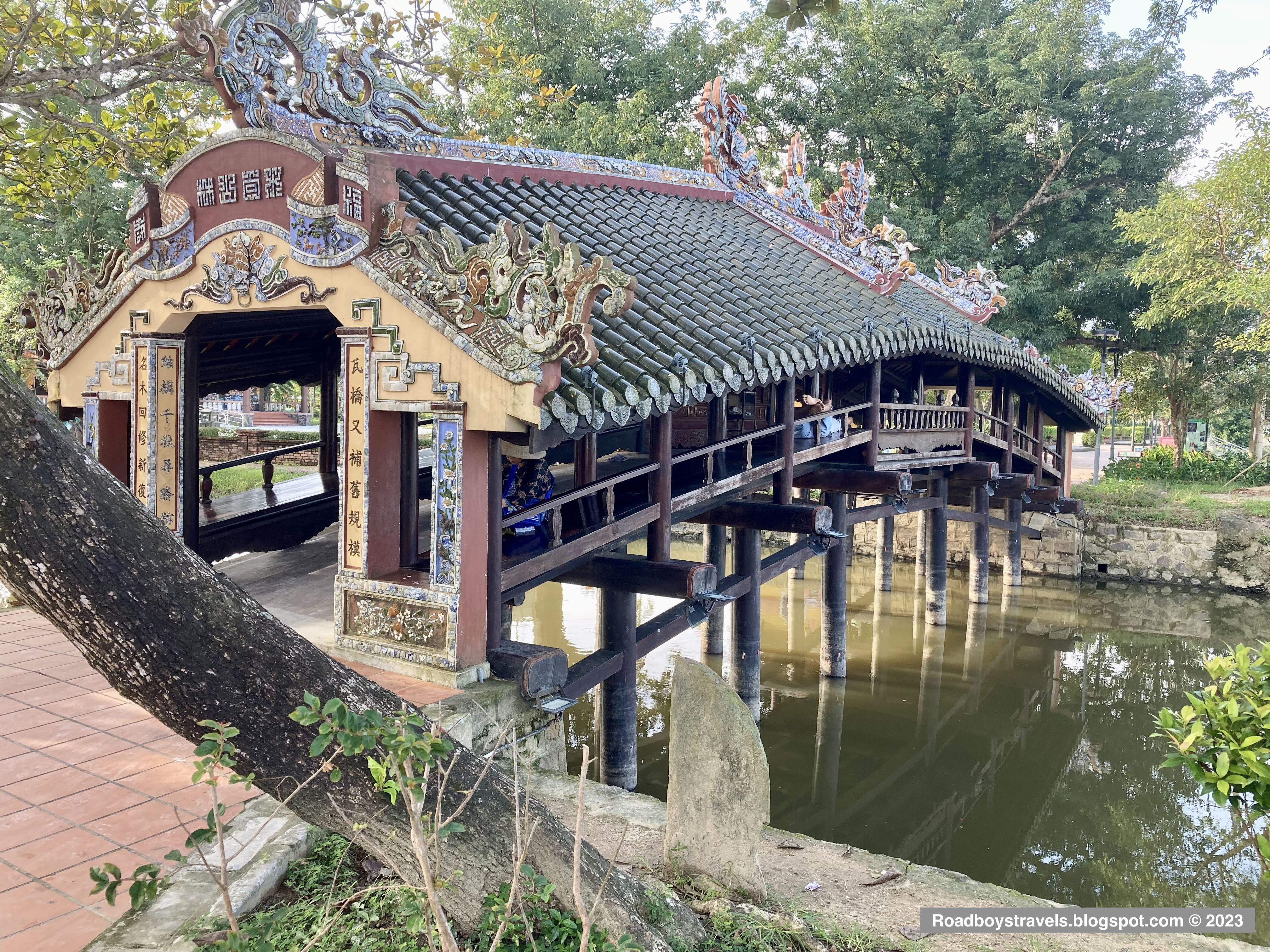
Bat Bridge

Riding along the canals we noted these stainless steel fishing boats at anchor along the way. Upon closer inspection we saw they were assembled using sections of fuselages from downed American jets from the Vietnam war.

Jet Parts Repurposed into Fishing Boats

After breakfast day two we toured Emperor Khai Dinh's Mausoleum. The elaborate mausoleum was designated a UNESCO World Heritage site in 1993. Khai Dinh, the twelth Emperor of Vietnam, had a relatively short a 9 year reign from 1916 to his death in 1925. 

Over his life he was never fully embraced by the Vietnamese public. Although he was likely gay, he fathered the last Emperor of Vietnam Bào Dai.   

Construction on the mausoleum began in 1920 and continued until 1931 (6 years after Kai Dinh's death). It is reported that he levied an enormous tax on his subjects to finance its construction.

The mausoleum is compact, yet exquisitely detailed. It is composed of architectural elements that borrow from Vietnamese, Chinese and European motifs. It is reached by climbing a wide steep staircase that leads to forecourts, temples, and additional stairs.

The Lower Forecourt With Protective Mandarin Statues
 
Upon entrance to the tomb itself you find Kai Dinh seated on an elevated sunburst throne cast in Marseilles. The ceiling is a spectacular fresco and wall panels are composed of inlays of broken pottery fragments (similar to those found at the Imperial Palace).

Throne Sculpture in the Tomb

Rows of Mandarin Forecourt Sculptures
 
After the visit to the mausoleum we collected our bicycles for a ride along the Perfume River. The river name is the result of the fragrant blooms that collect in the river in the fall from upriver orchards. Along the way we stopped at a market. Literally everything is for sale here from snakes to flowers, housewares to fresh produce.    
 
Market Day

Fresh Seafood in Abundance
 
Our ride ended at the Thien Mu (Heaven Happy Fairy Lady) Pagoda and temples. The 7 story pagoda was constructed in 1884 and is the highest stupa in Vietnam. 
 
 
Thien Mu Pagoda
 
This site became a major organizing point for the Buddhist movement and a site of major protests during the summer of 1963 after South Vietnamese President Ngo Dinh Diem's regime continuously showed strong preferences for Catholics and engaged in discrimination against Buddhists.

As a chilling historical reference to the protests, the auto driven by Buddhist Monk Thích Quang Duc to the busy intersection in Saigon where he set himself on fire is displayed. 
 
President John F. Kennedy said in reference to Malcolm Browne's photo of the self-immolaton that "No news picture in history has generated so much emotion around the world as that one". 

Despite being only 8 years old when I first saw the burning monk photo it would become an image I'd never ever be able to forget. 


Buddhist Protests in 1963

After visiting the Pagoda site we crossed the street to the river to a waiting "Dragon Boat" for an elegant lunch cruise along the river.

Hue's Dragon Boats

Our guides pointed out that most of Vietnam has only two seasons: Hot! and Damn Hot! After a full day of cycling in what they only view as Hot!, I can only imagine what summer's here are like. 

This was to be our last night in the completely amazing city of Hué. Tomorrow we ride and shuttle to Vietnam's City of Lanterns Hoi An.


Roadboy's Travels © 2023 

Sunday, December 24, 2023

Cycling SE Asia 2023 Part 4: Arrival Vietnam

Vietnam's Contrary Capital


My Vietnam Backstory

My life has been blessed. I have never had to shoulder a weapon in war, endure hunger or worry about having a roof over my head.  Overall my health has remained good for most of my 67 years and I have healthy children and grandchildren.

I was able to follow the American sequence for success. I became the first one in my family to attend and graduate from a University. It was at a time when higher education was still comparatively affordable. I worked hard and graduated debt free. And, the knowledge gained from college, allowed me to eventually found my own practice. 

But the one anomoly in my teen years was Vietnam. I never understood the Vietnam "conflict". My childhood in Oakland was framed by antiwar riots in Berkeley, SF State, and at Oakland's Clay Street Induction Center. 

I lived with very conservative parents. To them the psycho Joe McCarthy was a hero. They completely believed "commies" had infiltrated every level of the US government. In their eyes if communism was left unchecked anywhere, it would inevitably lead to soviet style domination everywhere. 

Kennedy and Johnson were perceived by them as lying liberals. But, when America's truly epic liar, Richard Nixon, became president they believed anything he said. As soon as I was able to vote I took great pleasure in using my vote to cancel out one of theirs.

I earned spending money during high school by working nights, weekends, and summers at the City owned parking lots in downtown and Jack London Square. The Clay Street garage I worked in was directly across the street from Oakland's Induction Center where all Vietnam draftees reported. Upon entering this building all youthful innocence was surrendered forever.

All day, every day, when I worked in my little parking lot booth at Clay Street I watched the endless lines of nervous young men being consumed by the Vietnam "conflict".

My resentment about eventually having to join that line, and possibly surrender my life for something three consecutive presidents and the US Congress never had the guts to call a war, slowly began to overwhelm me. I knew I had a future and I did not want to offer it up for something I could not understand and certainly did not believe in.

Now, don't get me wrong, I love my country. If an enemy were to attack our shores I'd willingly surrender my life and fight with my bare hands.


 Protesting The Vietnam War From the Clay Street Garage 

Photo: Oakland Local Wiki

All this led to one of the very few times in my life when I risked an open conflict with my father. I told him that, until someone could give me a damn good reason I could fully understand, I was unwilling to go to Vietnam and would seek asylum in Canada before surrendering to the draft. Dad muttered how much it hurt knowing his only son "had a yellow streak running down his back" and walked away from me. It was one of the most painful moments in my life.

Years later, dad quietly told me he had come to the conclusion I'd been right about "that Vietnam thing".

So to this day, the word Vietnam evokes an unresolved part of me. And, like most things in my life, confronting the unresolved is the only way I know to overcome it.

So my trip to Vietnam would involve far more than sightseeing.  


Hanoi

The history of Vietnamese Hanoi began in 1010 when Ly Thaí Tô established it as a strategic stronghold naming it "Soaring Dragon". 

When the Nguyen dynasty was established in 1802 Vietnam's capital was moved to Hué. 

In 1873 the French arrived and in 1887 the French military decreed Hanoi as the capital of "French Indochina".

The Japanese invaded and occupied Hanoi during WWII. 

After WWII control returned to the French colonists until their defeat at Dien Bien Phu in 1954. The country was left divided during the Geneva Conference. 

Elections were scheduled to reform the country under a unified government. The communists in the North, supported by the farmers in the south, were favored to win the elections. But when the leader of South Vietnam Ngo Dinh Diem refused to hold elections, the US government threw its support behind him. This left the capital of a Communist regime in North Vietnam while Saigon became the capital of South Vietnam. 

The Communist North, under Ho Chi Minh, commenced a guerilla war to recapture the South. American politicians quickly decreed that letting Vietnam fall to communism would enable the spread of communism throughout Asia. Of course, they never offered proof of those claims.

In 1964, LBJ capitalizing on a reported attack on US ships, proffered the Gulf of Tonkin resolution. It formed the excuse to escalate the Vietnam "Conflict". The US propped up and toppled successive (hopelessly corrupt) South Vietnamese regimes until our final defeat in 1976. At that time Vietnam was reunified with Hanoi becoming the capitol of the entire nation.

Now, almost fifty years later, Vietnam operates under the iron rule of the communist party. The party first attempted to create a centrally controlled economy. It failed and then unleashed the sleeping tiger of free enterprise. Today there are highly visible signs of prosperity everywhere. And, although average annual national income still remains painfully low at just $4,000/yr (compared to $6,000/yr in Thailand and $12,000/yr in China respectively), the Vietnamese people I met are happy and optimistic. They anticipate an increasingly brighter future. 

Hopefully, Vietnam's path to success will not be cut short by its pervasive culture of political and bureaucratic graft and corruption.


Beep Beep!

A westerner's first shock upon arrival in Hanoi is the traffic. There is no workable mass transit. In this city of over 8,000,000 residents there are swarms of scooters. Scooters are used for hauling unimaginable amounts of materials. We saw scooters with four (or more) riders. Besides cars, the rideshare app Grab offers "hop on the back" scooter services allowing you to quickly book a quick, cheap ride anywhere.

Scooters Scooters Everywhere

Western visitors must take time to understand the rules of the road in Vietnam. It would be suicidal for a westerner to rent a car and attempt to drive in Hanoi traffic. Lane markings are irrelevant. Riding on sidewalks is common. Red lights are mere suggestions. 

Yet, after a day, the delicate etiquette of Vietnamese traffic started to make sense.

Everyone honks at each other all the time. But the beep beeps are not "get out of my way" rage honks like in the US. They are more of a "Hey! be aware, I'm here" safety behavior. While riding bikes we became grateful for those thoughtful little beeps that drivers offered as they came upon us and began to pass.

The next thing visitors must learn is how to cross the street. In Vietnam pedestrians simply become little human pebbles disrupting the stream of endless traffic. Once you step off the curb into the swarm of traffic and slowly proceed to cross traffic just flows to either side of you.

Crossing rules are strict and important: 

1. First you size up traffic. 

2. Slowly step off the curb directly into traffic. 

3. Walk forward slowly with purpose. 

4. Never step backward or change direction. 

5. Never run. 

It takes courage to cross swirling Hanoi traffic, but as soon as you become comfortable with how traffic constantly adapts, crossing becomes completely natural.

We arrived a day before our formal tour was to begin, so we booked our own hotel in Hanoi's old quarter for the first night. It was a lovely little boutique hotel (Royal Palace 2). I booked a spacious room with a big balcony overlooking the bustling street scene below. My room rate (including fast WiFi and a full breakfast) set me back $65 (including all fees and tax).


 First Night Hotel in the Old Quarter

We visited a walk-up Banh Mi stand for very serviceable dinner (which cost about a buck). Even with an eye popping exchange rate of 24,000 Vietnamese Dong to $1, it did not take long to realize that travel in Vietnam is an amazing bargain.

The next morning we slept in and then met up with our Vermont Bike Tours (VBT) group at the swanky nearby Hanoi Melia Hotel in the heart of Hanoi's diplomatic zone. 

Our VBT tour began with a detailed walking tour of Ho Chi Minh's mausoleum and residences and our welcome dinner.

The following day was packed. We began with a walking tour, took rides in cyclos (bicycle versions of a rickshaw), toured the Temple of Learning, the infamous Hanoi Hilton, religious sites and finished with an early evening performance of Hanoi's famous water puppets. In between were amazing meals at some very nice restaurants.

Bicycle Street Commerce

A Cyclo Ride Through the Old Quarter

The Hanoi Hilton

Built by the French, the Hanoi Hilton was clearly designed for the purpose of torture and brutal incarceration. Today, most of it has been demolished to make way for new government structures, but the main facade exists along with a series of displays. The displays are now used as a propaganda tool to stress the cruelty of the French (true), but then goes on to stress how "humanely" the Vietnamese treated US fliers (bullshit). John McCain's inability to reach high enough to comb his hair stands as testimony to those lies. 

Today everywhere in Vietnam there are smiling images of "Uncle" Ho Chi Minh. The communist party has attempted to elevate him to the status of diety. It is most evident when you visit his huge mausoleum (where, despite his wishes to the contrary, his glass boxed corpse now resides on permanent display like Lenin in Russia). Hearing his story from the Vietnamese perspective did alter my perception of him a bit.        

Ho Chi Minh's Mausoleum 

After the departure of the French Ho Chi Minh (HCM) refused to live in the elegant presidential palace the French had built. He instead chose to live in a modest home nearby.

Ho Chi Minh's Nearby Residence


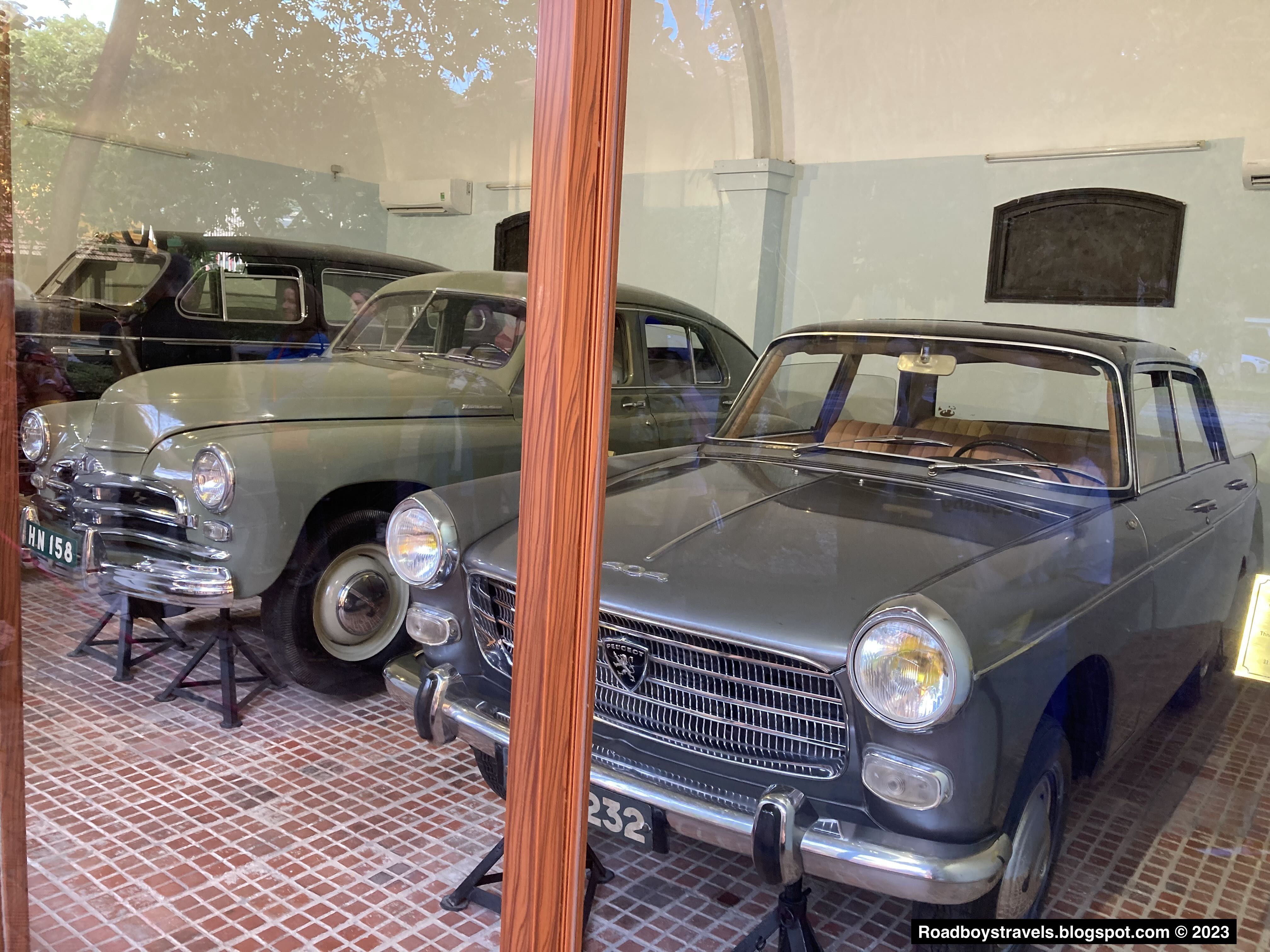
Ho Chi Minh's Autos Are Also Preserved

But once you get past all the HCM stuff, the actual City of Hanoi is really a delight. The streets are covered in trees. The French influenced legacy architecture is beautiful, the cultural amenities are rich, and Vietnamese food is wonderful. 

But, more than anything, the gracious and friendly people of Hanoi form the real treasure of this City. 

Green Canopy Trees Shade Narrow Streets With Picturesque Lanterns in Hanoi's Old Quarter

An Evening with Hanoi's Water Puppets


Hanoi Infrastructure is Reckless
 
After the heat of Bangkok, the 68° temperatures in for our three days and two nights in Hanoi were very welcome. 

Now coming to day three, we faced an early morning flight to our next destination Hué.


Roadboy's Travels © 2023

Tuesday, December 19, 2023

Cycling SE Asia 2023 Part 3: A Day at Ayutthaya's Ancient Temples

A Royal Summer Palace, Spectacular Temple Ruins and A Temple of Shopping

When planning this trip one of my goals was to visit Cambodia's famous Siem Reap temple ruins. But knowing Cambodia's political instability, coupled with reports that the famous Angkor Wat site is frequently overrun by tourists left me reconsidering it. Then I researched the reality of air connections from Siem Reap back to Phoenix (abysmal) and started considering alternatives. 

After doing a bit of research I decided a day trip to the Ayutthaya Historical Park near Bangkok offered a great alternative to flying to Cambodia to tour Angkor Wat. We settled on a full day tour that also included a stop at Bang Pa-In Royal Summer Palace.

It turned out to be a very full (and pretty danged hot) day of sightseeing but well worth the time spent. We stopped at three temple sites and walked among some stunning temple ruins. 

After a couple hours drive our tour began at the Bang Pa-In Royal Summer Palace. Originally built by King Prasat Thong in 1632. It fell into disuse in the late 18th and early 19th centuries. In the mid-19th century King Mongkut began a restoration that was continued with most of the major present buildings constructed between 1872 and 1889 by King Chulalongkorn. The architecture is a hodgepodge of whatever Euro monarchist architectural styles were popular during its construction. There are little snippets of Versailles here and there, European statuary etc.

The palace has played host to visiting royal dignitaries, weddings and funerals. But visiting the site requires legs and shoulders to be covered. This resulted in the quick purchase of a pair of baggy elephant pants. At a cost of about $2, they became an instantly cherished souvenir and will serve as a perfect pair of PJ's.

Today, the palace buildings and grounds do not appear to be used much with many demonstrating a state of deferred maintenance. My favorite structure was the Aisawanthipphaya-At Pavilion located on an island in the middle of the palace canals.

The Aisawantthippaya-At Pavillion 
 
The palace was also a site of suffering for its builder King Chulalongkorn. In an 1880 journey by boat to the palace, the boat carrying his pregnant nineteen year old wife: Queen Consort Sunandha Kumarirtana and his two year old daughter capsized. Since Thai law at that time strictly forbade subjects from touching a royal (under punishment of death), guards prevented anyone from rescuing them.

Upon departing the Summer Palace we began our day visiting three Ayutthaya temple sites. Ayutthaya was founded in 1350 and was the second capital of the Siamese Kingdom. A center of global diplomacy it is strategically located on an island surrounded by three rivers that connect the city to the sea. It flourished from the 14th to 18th centuries. The city was burned to the ground by the Burmese army in 1767. Although it was never rebuilt, and the capital was moved to Bangkok, Ayutthaya's remains and Prangs (towers) provide an extensive archaeological site and a window into Ayutthaya's past splendors. Ayutthaya is designated as a Unesco World Heritage site.
 
The first site we visited was Wat Chai Mongkon with its reclining Buddha. This site is relatively compact.

Wat Yai Chai Monkon

Phra Buddhasaiyart

The giant 95' reclining Buddha is reclining on its right side with head on a pillow. It symbolizes Buddha in his last illness just before entering parinirvana. The reclining Buddha was draped in gold fabric. This temple structure was the best preserved of the three sites we visited.

Wat Chaiwatthanaram

The next Ayutthaya temple site we visited was the spectacular Wat Chaiwatthanaram. This site borders a river and is very large. Structures here are undergoing restoration due to flood damage. 

Shops directly accross the street from the site offer short-term rental of traditional Thai garments for use by families visiting the site. Seeing Thai families of all ages wearing traditional garments and changing light levels added special character to the site.

Families Taking Photos in Traditional Clothing


 Changing Light and Cloud Patterns

The final Ayutthaya temple stop was Wat Maha That. This site is also quite large. It is known for its enigmatic Buddha head that has been captured over time by tree roots.  

Buddha Head in Tree Roots at Wat Maha That

The tour left me with the understanding that any real exploration of Ayutthaya could take weeks. The durability of the (primarily) brick construction left me in awe of the skill of its designers and builders. 

We crossed the street to eat dinner at street food stands at Ayatthaya's Night Market before the almost 2 hour drive back to Bangkok. The tour concluded at Bangkok's temple of wretched excess the Icon Siam. This is a five story retail mecca where you can buy everything from precious jewels to handbag's from Longchamp or Vuitton, even a new Maserati.

Above five or more levels of stores is a top level food terrace with a 4-story fully programmed drape style circular waterfall. 

The whole Icon Siam complex is set upon the banks of Bangkok's Chao Phraya River with access to ferry boat service. 

A whole day of sensory overload.


The Top Level Terrace Food Hall at Icon Siam 

Icon Siam was the complete opposite of the Chatuchak Weekend Market we visited on our first day. 

The mall somehow illustrates the paradox of Thailand as a nation undergoing political chaos. Last May's free and fair national election resulted in a landslide win for the 47 year old, Harvard-educated reformist and pro-democracy candidate, Pita Limjaroenrat. To date the military-appointed senate has prevented him from taking office. Much like many nations of the world Thailand's "Haves" would rather not cede an inch to the nation's "have nots".

To see such a luxurious mall serving a small population with immense concentrated wealth in a nation where the average annual total take home wage is only $7,000 underscores the extreme discrepancy in wealth inequality present here.

Thailand, a country I found to be filled with gracious people and known as the "Land of Smiles" appears destined be headed for rough seas.

So much more to explore in Thailand, but the morning brings a flight to Vietnam.


Roadboy's Travels © 2023

Thursday, December 14, 2023

Cycling SE Asia 2023 Part 2: Getting to Know Bangkok

Scary Big!

After more than 24 hours of travel we crashed like the Titanic. 

But, never underestimate the medicinal value of a long warm shower and a good nights sleep. When morning arrived I had to face down the immediate reality of Bangkok's size and complexity. It is perhaps one of the worlds most intimidating cities. It is huge, crowded, choked in traffic, and everything (except traffic) moves at a frantic pace. So my first challenge was to begin the process of getting some food and determining how to get around.

Seeing a 7-11 or Circle K on every corner I began with a trip next door to get the makings for a quick breakfast. After breakfast it was time to start deciphering how to get around.

Here are some transportation basics. It would be complete lunacy to rent a car here. A western driver does not have the skill set to comprehend driving in Bangkok. So abandon any thoughts of that. Here transportation must provided by those who understand its traffic flow. 

Bangkok is served by a national rail system, a skytrain (BTS), a subway (MRT), buses (BMTA) and a private airport rail link. For the most part everything is technically integrated yet frustratingly separate. And for everything else there is Grab. We started by riding the Skytrain and noted it has direct connections to MRT stations, except each system doesn't offer any integrated ticketing. So you get off a Skytrain and then must go buy an MRT ticket. Most visitors are astounding how inexpensive transportation is here.

Day One: The Chatuchak Weekend Market

Since we arrived on a weekend, and we could get there on one transport system (the BTS Skytrain), we decided we'd join the 200,000 (mostly local) visitors each weekend to the Chatuchak Market. The market features more than 15,000 market stalls distributed in 27 different sections. The market is a complete fire trap, it makes zero barrier-free accommodations, is a health department nightmare, and a lot of fun. 


The BTS                         

The BTS (Chong Nonsi) stop was just steps a way from our AirBNB, so we purchased tickets from a human at a real ticket booth (BTS vending machines are strictly cash) and waited for the train. We'd need to transfer at Siam Station and then it would be smooth sailing all the way to the market. The market is free and it is quite simply overwhelming. It is divided into 27 sections including clothing (think fake designer goods), housewares, design and decor, fresh food, perfume, serious art, prepared foods, pets, and everything in between.

Fine Silk, Toys, Fabrics, Flowers, Thai Massage

Woodworking and Housewares

Street Food Stalls

Even PJ's for Creepy Aryan Children

Art Studios

I almost left without seeing the art studios and galleries tucked off to the side by one of the major entrances. Glad we ventured back to check them out. Quite simply. the art here was serious, much of it was pretty wonderful.

After most of a day spent lost in the market while experiencing a mild version of Bangkok's legendary wet heat Jetlag became an issue and it was time to call it s day.  We detoured into a nearby Tops Market to finish provisioning the AirBNB.

My initial fear of the city melted in a single day thanks to a quick understanding of the safe, efficient, and immaculate BTS system and the warmth of the Thai people living in this human anthill.


Day Two: The Damnoen Saduek Floating Market and the Maeklong Railway Market.

Every time I've researched "Top 10" lists of sights to see in and around Bangkok floating markets seem to be on the list. Somehow I thought that the picturesque river commerce was in the immediate area of the city, but a little research made me realize that while there are many floating markets, all require some traveling distance, so I booked a (very) full day tour that included the Damnoen Saduek Floating Market and the Maeklong Railway Market. So the morning would be spent at the floating market and the afternoon would be spent awaiting the 2:30 PM scheduled arrival of the train into Maeklong station. 

The fascinating thing about the rail market is that the railway tracks run literally right through an open air market. So as the train sounds its horn signalling its arrival, merchants must quickly pull back their shade canopies and move merchandise.    

Our Guide Lita

The day trip picked us up and we were given an overview description of the floating market.  This market was constructed by King Rama IV to connect the Mae Klong and Tha Chin rivers. It was even upgraded for an anticipated visit to Thailand by Queen Elizabeth. In 1971 the Tourism Authority of Thailand decreed the market a tourist attraction. And a first class total tourist attraction (tourist trap) it is. You board long boats in an area reminiscent of Disneyland's Jungle Boat Cruise. Then you motor into a series of canals that get tighter and more crowded the further you go. The boats stop for you to buy coconut ice cream or skewers of meat or mango and sticky rice. And everything comes at a price higher than anywhere else. When we left the boats the land merchants had the same items for about half the price. And if you see something you actually want just look at it seriously. Then ask the price. Then say no I think I'll wait and the price will be dropped in half. I bought a casual linen shirt (that I have worn continuously on the trip) for about $2.

Produce, Flowers, and Street Food (on the water)

Lots of Commerce

Lots of Engine Exhaust

After our time on the floating market it was off to see the railway market. Here timing is everything as the train has a schedule to keep. 

First everyone walks the market and gawks at the fish, flowers, produce, and seemingly everything else anyone might have even a passing interest in.  The market is narrow and the awnings are low (I smacked my head plenty of times). Then everyone sort of finds their spot to witness the train's arrival. There is a curve so you hear the slowly approaching train before you see it. It is a well choreographed event with the awnings all getting retracted and goods moved out of harms way. Gawkers are warned to stay behind red lines on the sidewalks.

Before the Train

The Train Arrives

As quick as the awnings came down, they go back up for about an hour until the train is ready to depart and the whole well choreographed process is repeated. As for me I was ready to sit indoors in some good old air conditioning. It was time for a cold beer and some mango and sticky rice.

Mango and Sticky Rice

The tour returned us to Bangkok, dropping us at Bangkok's over-the-top shopping center Icon Siam. That is a post of its own.


Roadboy's Travels © 2023


Thursday, December 7, 2023

Cycling SE Asia 2023 Part 1: The Journey to Bangkok

Off to a Great Start

"One night in Bangkok makes a hard man humble"

Tim Rice - Chess  

The culmination of travel in 2023 for Roadboy is my long awaited return to Asia.

Four decades ago I made my first trip to Asia. The trip was limited to Japan and Hong Kong. At that time Japan was in its full glory as the globe's ascendant economic and manufacturing powerhouse. 

Similarly, Hong Kong was under its last vestiges of British control. It was stunning. We traipsed through a myriad of designer factories, ogled the stunning new Hong Kong and Shanghai Bank Building, visited Hong Kong Disney, and the (now scraped) Tiger Balm Gardens.

It was a truly magic time in my life; anything seemed possible. The whole world awaited me.

In the decades to follow, there would be subsequent trips to Japan and Singapore. But never any journeys to Southeast Asia, particularly Thailand and Vietnam.

But here I must wind the clock back to 1980 and my first architectural job (in Seattle). At that firm (WGHT) there was a special colleague named Boonsong. Mr. Boon was a talented, hard working Thai architect (and a damned great human being). He was working in Seattle on a temporary basis to earn enough money to fund his son's education at the University of Washington. His migration and employment in Seattle was his only option as Thailand prohibited citizens from taking money out of the country. 

At home he was a renowned campus architect for a major University and he regaled me with his stories of his beloved homeland. the result was a desire to visit Thailand someday.

So this trip begin with a short visit to Bangkok. 

Our trip itinerary began with a flight from Phoenix to LAX. Then we took a (very) long flight to Tokyo's (very nice) new Haneda Airport arriving at 4:45 am in the morning. Haneda at that hour turned out to be an eerie place. You get off a flight and walk through this immense airport with seemingly no one else there.

Ms. M 

Haneda at 4:45 AM

At Haneda we had a six hour layover before connecting to our JAL flight for the final leg to Bangkok. 

Then just before our flight to Bangkok the flight crew arrived at the gate. I admit being touched when they lined up smartly, turned to face the departure lounge and bowed in reverence to the passengers they would serve. It was a simple, yet deeply meaningful, gesture of respect.

The JAL flight was as smooth as the bow and but when we arrived into Bangkok we were even more tired and more dazed. All we wanted to do was shower and sleep.

But at Suvarnabhumi airport our stupor was simply compounded by the mass of traveling humanity present at 4:00 pm on the Friday before a three-day weekend. The holiday meant that traffic into Bangkok was even more choked than usual. In fact, Klass our AirBNB host suggested we find a place to eat in the airport and wait about 4 hours before trying to make our way into the city. 

We headed his advice and eventually caught a Grab to our AirBNB. Grab is to Southeast Asia what Uber is to the US. In fact, Grab bought out Uber's Asian operations.

Once in our AirBNB, it was finally time to shower and sleep. 

Tomorrow we could start to figure out some trip logistics.


Roadboy's Travels © 2023